
TABLE OF CONTENTS
Introduction
Feefo's Q&A Dashboard provides businesses with a comprehensive set of metrics and insights to track the performance and conversion rates of customer questions and interactions. These metrics offer valuable data points to understand customer engagement, response effectiveness, and ultimately, drive business growth.
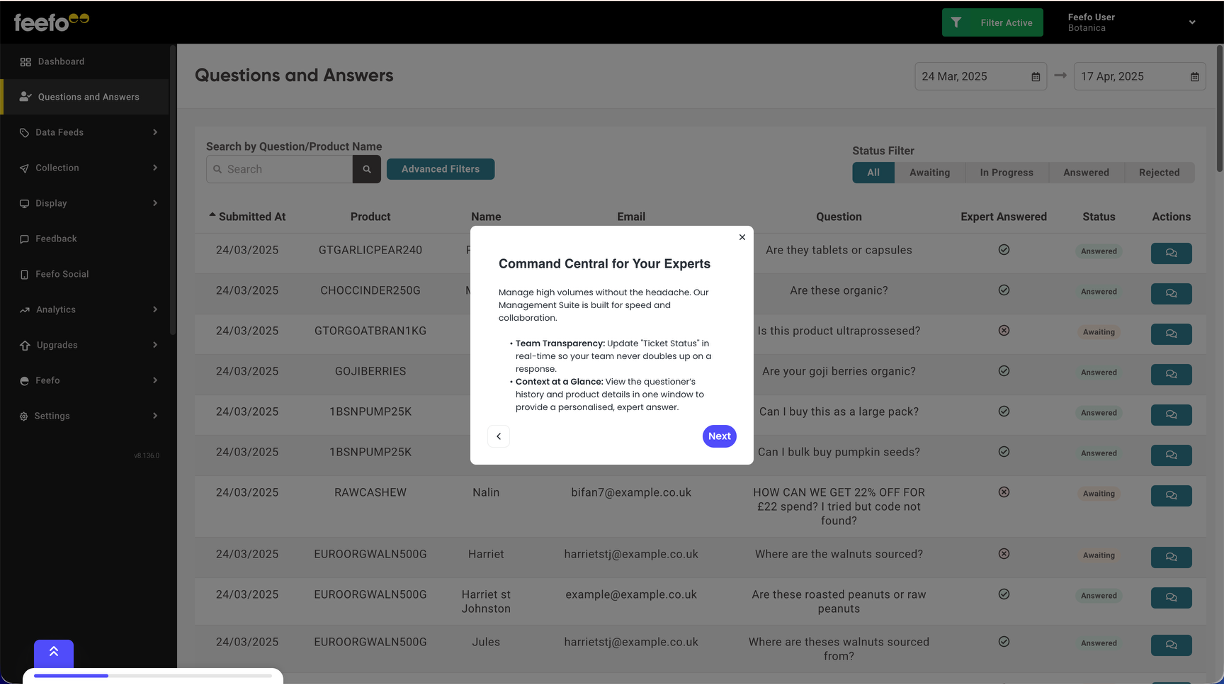
Take a quick tour of our Q&A feature:
Let's delve into the key metrics displayed on the Q&A Dashboard:
Report Filters
Report filters allow users to narrow down the data displayed in their reports based on specific criteria or conditions. Here's what report filters enable users to do:
| Field | Description |
| Merchant Name(s) | Enter the name or identifier of accounts available to the user. If you select multiple accounts you see the aggregation in the metrics |
| Question Created Date | Choose from preset date range options or create a custom range. |
| Tag Key | Choose a tag key to display particular metrics. |
| Tag Value | Choose a tag value to display particular metrics. |
Performance
This dashboard serves as a Strategic Operations Hub for your customer engagement team. It transitions from high-level volume metrics to granular performance data, allowing you to measure how effectively you are resolving pre-purchase friction.
Here is a summary of the three core insights this dashboard provides:
1. Engagement & Efficiency Metrics
The top-level cards track the "Health" of your Q&A ecosystem.
-
Conversion Potential: By comparing Questions Asked vs. Questions Answered (%), you can see exactly how many potential sales are currently "stuck" in the funnel.
-
Team Agility: The Average Response Time (h) is your key KPI for customer satisfaction; the lower this number, the higher the likelihood of capturing a lead while they are still on your site.
2. Operational Workflow & Quality Control
The breakdown tables provide a "Post-Mortem" on your moderation process:
-
Status Tracking: The Question Status Breakdown identifies bottlenecks (e.g., a high volume of "Awaiting" questions).
-
Content Filtering: The Rejection Reason Breakdown helps you understand why users are failing to submit valid questions (e.g., spam vs. off-topic), which can help you refine your on-page instructions.
3. Product & Staff Intelligence
The bottom-tier tables shift focus to specific assets and human capital:
-
Inventory Gaps: Top 10 Products with Most Questions highlights where your product descriptions might be lacking. If one SKU has a high question count, it’s a signal to update that product page.
-
Leaderboards: Agents Who Answered the Most identifies your "Knowledge Champions," allowing you to reward top performers or redistribute the workload to improve response times.
| Field | Description |
| Questions Asked(card) | The count of questions asked
Calculation: count of distinct question. |
| Questions With Answer | The count of questions asked and received at least one answer
Calculation: count of distinct question.id where question.status=ANSWERED |
| Questions With Answer(%) | The percentage of questions asked and received at least one answer
Calculation: Questions With Answer/Questions Asked |
| Average Response Time(h) | The average time spent(h) between a question asked and answered Calculation: AVG(DIFF_HOURS(question.created_time,answer.created_time)) |
| Question Status Breakdown | A breakdown table showing how many questions are ANSWERED/AWAITING/REJECTED and the percentage of total |
| Rejection Reason Breakdown | A breakdown table showing the count of questions for each rejection reason and the percentage of total |
| Questions With Answer(chart) | A bar chart showing the count of questions asked(orange line) and the count of questions with answer (blue line) by date |
| Top 10 Products with Most Questions | A table showing the top 10 product SKU with the most count of questions, along with product title, parent SKU and count of answers. |
| Agents Who Answered the Most Questions | A table showing responder name, merchant name, count of answers and the percentage of total. the table is sorted on count of answers in descending order. |
Conversion
This dashboard is the ROI Engine of the Q&A tool. While the Performance dashboard focuses on "how fast" you respond, this one proves "how much" those responses are worth by linking customer inquiries directly to closed sales.
Here is a summary of the core insights this dashboard provides:
1. Attribution & Conversion Depth
The dashboard tracks "Assisted Conversions" across three specific levels of precision:
-
Direct Impact (SKU Level): Shows the "perfect" conversion—someone asked about a specific item and then bought that exact item.
-
Brand Affinity (Parent SKU Level): Tracks users who asked about a specific model or style but ended up purchasing a variation (e.g., a different color or size) within the same product family.
-
Total Ecosystem Value (Order Level): Measures general intent. It shows that even if they didn't buy the exact item they asked about, your answer kept them on your site long enough to buy something else.
2. Revenue Attribution
-
Monetary Value: The Revenue Received field provides a baseline currency value for orders influenced by the Q&A widget.
-
Note for Accuracy: Since the data tracks unit price rather than quantity, this should be viewed as a minimum "Total Order Value" rather than a literal accounting of every item in a bulk cart.
3. The "Customer Journey" Audit
-
The Sale Details Table: This is your most granular piece of evidence. It allows you to audit the specific questions that led to a sale.
-
Strategic Use: You can use this to identify "High-Value Questions"—if a specific type of answer (e.g., "Yes, this is compatible with X") consistently leads to a sale, you can automate that response or add it permanently to your product description.
| Field | Description |
| Conversion Rate (SKU Level) | The percentage of people who asked question and bought the same SKU Calculation: Count of people who asked question and then bought the same SKU/Count of people who asked question |
| Conversion Rate (Parent SKU Level) | The percentage of people who asked question and bought anything with the same parent SKU Calculation: Count of people who asked question and then bought anything with the same parent SKU/Count of people who asked question |
| Conversion Rate (Order Level) | The percentage of people who asked question and bought anything Calculation: Count of people who asked question and then bought anything/Count of people who asked question |
| Revenue Received | On order level, how much revenue the merchant has received, breakdown by currency
|
| Sale Details | A table showing question and sale details for questions that ended up with a sale. |